| Visualising Roman Ironworking in the Weald |
|---|
| AI Generation of Images ▲ |
|---|
 Having recently begun experimenting with AI-generated imagery, I thought it would be interesting to try to visualise the Roman iron industry of the Weald. I have used the Bardown ironworking site near Stonegate in East Sussex, along with its supply route, as my working example.
All the images on this page were created using either Google Gemini, OpenAI ChatGPT or Microsoft Designer, with a focus on historical accuracy wherever possible. I have also used Anthropic Claude to help refine and expand my descriptions, as it is particularly good at adding relevant detail and context that I may have overlooked.
Please note that due to the nature of AI image generation, small anomalies or anachronisms may appear in some images. Nevertheless, I believe they give a reasonable and broadly accurate visual impression of the process. To view a larger version of any image, simply click on it and a popup will appear.
The sequence I will follow traces the full journey of iron from the ground at Bardown to the coast, covering each stage in turn:
- Digging and extracting the iron ore
- Producing charcoal to fuel the furnaces
- Loading and firing the bloomery
- Extracting the blooms and working them into skelps
- Loading the skelps onto carts for transport to the river via sceap/scip street to Burgham
- Transferring the skelps from cart to barge for the journey to Bodiam
- Loading the skelps onto sea-going vessels for onward transport via Portus Lemanis (Lympne) to Boulogne
Please be aware that there is a treasure trove of iron working information on the Wealden Iron Research group's website
There is also our page on the Bardown to Boulogne iron route
|
| |
|---|
Breaking Ground: Excavating Iron Ore in the Weald ▲ |
|---|
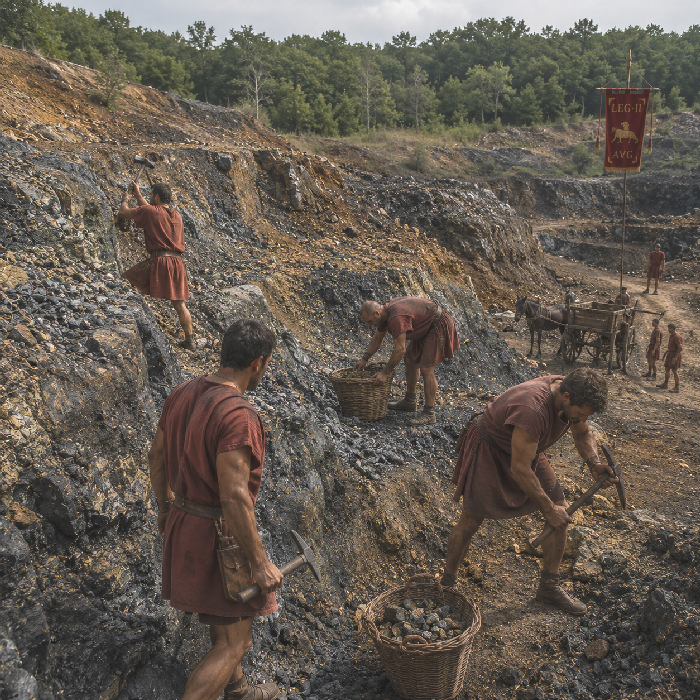 Before a single bar of iron could be hammered out on an anvil or loaded onto a cart, the process began in the ground itself. In the Weald of Roman Britain, iron ore lay relatively close to the surface, making open-cast mining the most practical method of extraction — no deep shafts or tunnels, but instead a slow, methodical stripping back of the earth.
The Excavation Site
The scene would be one of organised disruption. A wide, shallow pit has been cut into the reddish-brown earth, its sides stepped or terraced to allow workers to move up and down safely with their loads. The soil here is visibly iron-rich — streaked with rust-coloured ore, pale clay, and dark patches of mineral deposit. Exposed tree roots mark the edges where the forest has been cleared back to make way for the digging.
The Workers
Teams of labourers work in stages down the face of the pit. Some swing iron-tipped picks into the compacted earth to loosen the ore-bearing rock, while others crouch to sort through the broken material by hand, separating the denser, reddish ironstone from worthless spoil. The discarded waste is piled along the edges of the pit in low banks — earthworks that in some parts of the Weald are still faintly visible in the landscape today.
Wooden-handled shovels and antler picks move the loosened material into wicker baskets or simple wooden troughs. Once filled, these are hauled up the terraced sides of the pit by hand or passed along a chain of workers to the surface above.
Supervision and Record-Keeping
At the rim of the pit, a figure with a writing tablet oversees the work — tallying baskets, directing labour, and ensuring that the ore being extracted meets the quality needed for smelting. The Roman administration left little to chance; iron production in the Weald was a state-managed enterprise, and output was carefully monitored.
|
| |
|---|
Timber and Charcoal: Feeding the Furnaces ▲ |
|---|
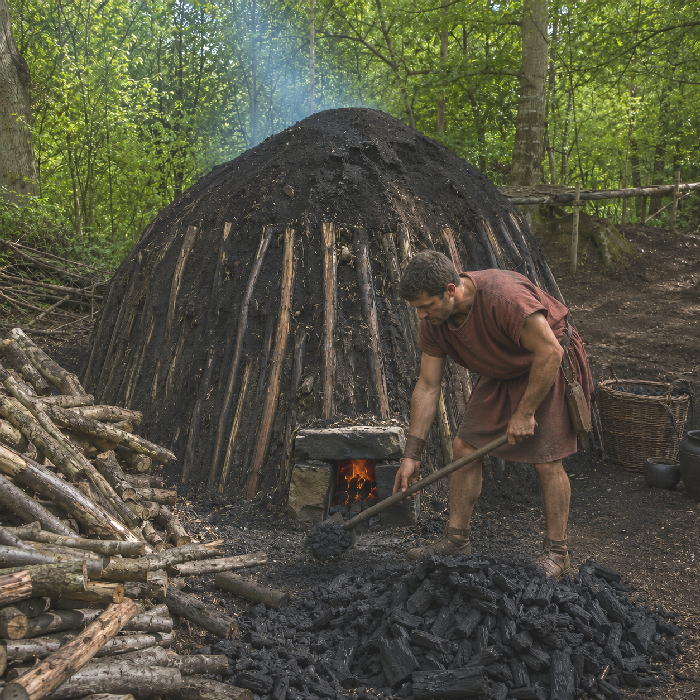 The great forest of Silva Anderida that once blanketed much of the Weald was, during the Roman period, under constant and enormous pressure. Timber was felled not only to fuel the ironworking industry but also to supply the shipyards of the Classis Britannica, providing the raw material for river barges, coastal transport vessels, and warships. The combined demands of iron production and shipbuilding meant that the forest was in a state of continuous retreat, its boundaries pushed steadily back as Roman industry consumed it decade by decade.
For the bloomeries, the key product was not timber itself but charcoal. Wood burns at temperatures insufficient to smelt iron, but charcoal — produced by burning timber slowly in a low-oxygen environment — burns far hotter and cleaner, making it the essential fuel of the ancient ironworker. Producing it was a skilled and time-consuming process. Felled timber and collected branches were carefully stacked into large, dome-shaped mounds, packed with turf or clay to restrict the flow of air, and then lit and left to burn slowly for several days. The result, when the mound was carefully opened and cooled, was the dense black charcoal that the bloomeries depended on.
This image captures that process in action — Romans felling trees and gathering branches at the forest edge, and loading the cut wood into charcoal ovens to begin the slow burn that would eventually produce the fuel needed to turn iron ore into usable metal.
|
| |
|---|
The Bloomery at Work: Loading the Bloomery ▲ |
|---|
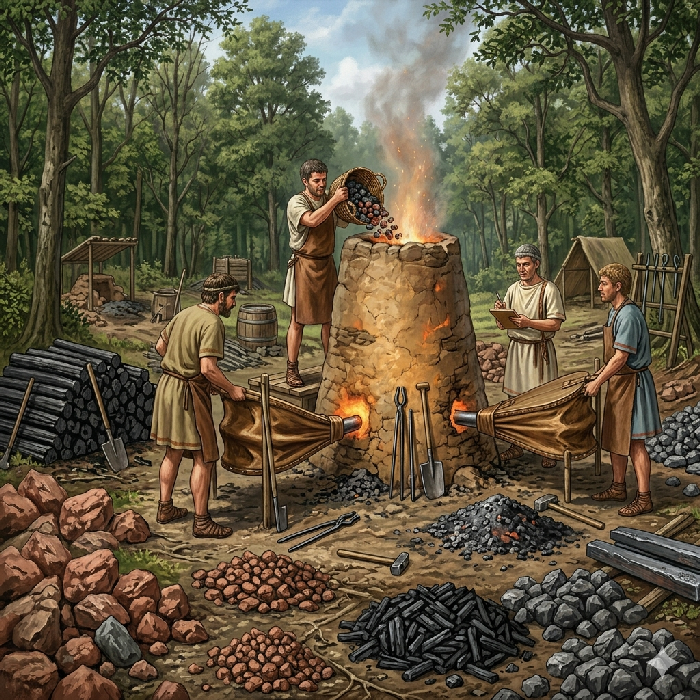 This image portrays a Roman-era iron smelting site in full operation, set in a clearing among the dense temperate woodland of the Weald. At the heart of the scene stands a large, tapered bloomery furnace built from clay and stone, radiating heat from within.
The Smelting Process
A worker stands on a wooden platform at the top of the furnace, tipping a wicker basket of iron ore and charcoal down into the chamber. Smoke and sparks drift upward as the fresh material meets the fire below. On either side of the furnace, two men work large leather-and-wood bellows, driving air through clay pipes — known as tuyères — into the base of the furnace. This constant supply of oxygen is what sustains the temperatures needed to strip the iron from the ore.
The Site and Its Materials
The foreground is laid out with the essentials of the trade: heaps of jagged, reddish-brown iron ore and mounds of black charcoal waiting to be fed into the furnace. To one side, a number of finished iron bars rest on the ground — the tangible result of hours of smelting and hammering, and the reason the whole operation exists.
The Workers
The men are dressed practically in tunics and leather aprons, offering some protection against heat and sparks. One figure stands slightly apart from the rest, holding a wooden writing tablet and stylus. He appears to be recording output or managing the logistics of the site — a small but telling detail that speaks to the organised, administratively minded nature of Roman industrial production.
|
| |
|---|
A bloom taken from the bloomery ▲ |
|---|
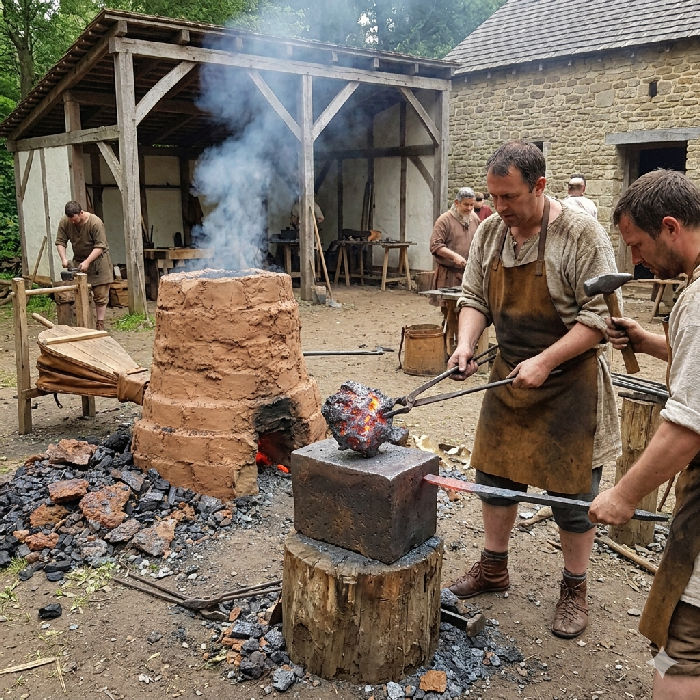 This image reconstructs a Roman-period iron smelting operation, likely set in a woodland region such as the Weald. The scene captures the critical moment when a freshly smelted "bloom" — a raw mass of iron — is moved from the furnace to the anvil for working.
Foreground: Working the Iron
At the centre of the scene, a jagged, glowing mass of orange and black metal is gripped by long iron tongs. This is the bloom — a rough mixture of metallic iron and liquid slag. It rests on a large, rectangular block anvil: a heavy, dark, pitted cube of iron set on a solid wooden log, accurately reflecting Roman-era tooling rather than the horn-shaped anvils of later periods. Two men in earth-toned tunics and heavy leather aprons work alongside it — one steadying the bloom with the tongs, the other raising a forging hammer, ready to strike.
Midground: The Smelting Setup
To the left stands a beehive-shaped bloomery furnace built from clay and daub, glowing at its base where the tapping hole allows slag to drain and air to enter. Smoke rises from the top, showing the fire is active. A large leather bellows in a wooden frame feeds oxygen into the charcoal fire, driving temperatures above 1,200°C — hot enough to reduce iron ore into metal. Around the workspace, piles of charcoal and reddish-brown iron ore are stacked on the ground.
|
| |
|---|
The Output of a Roman Bloomery: Iron Skelps or Currency Bars ▲ |
|---|
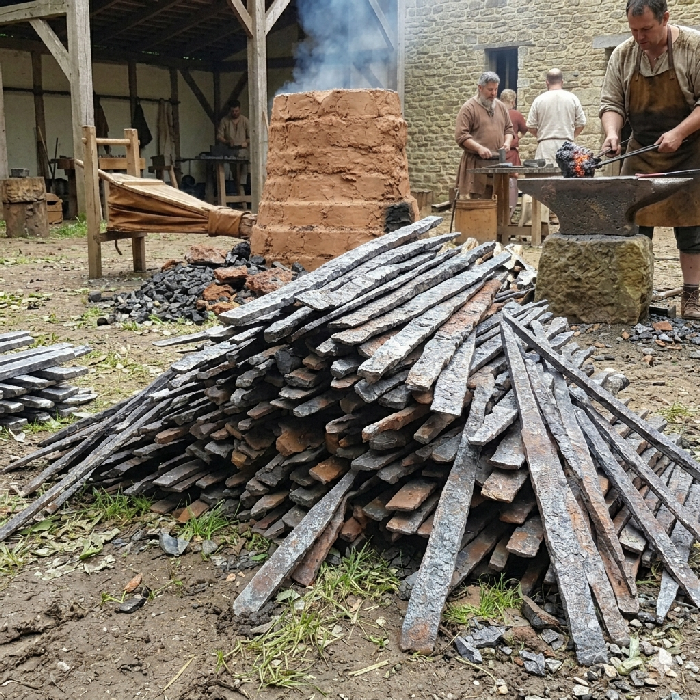 This image takes a closer look at the finished product of a Roman smelting operation — iron in its semi-processed state, ready to be passed on to specialist blacksmiths for further working.
Foreground: The Iron Bars
Dominating the scene is a large, loosely stacked pile of iron skelps, also known as currency bars. These are long, flat, narrow strips of wrought iron, dark and rough-surfaced, bearing the marks of repeated hammer blows. Some taper slightly at the ends — a characteristic feature of Roman iron bars, which made them easier to bundle and transport. Each strip represents the end result of forging down a raw bloom: by hammering the spongy mass of iron into these uniform shapes, the smiths have already driven out most of the slag, leaving dense, workable metal behind.
Midground: The Working Site
The familiar block anvil sits in the background, though a horned anvil has crept into the workspace — a small reminder of how difficult it can be to keep modern equipment out of historical reconstructions. The clay bloomery furnace is still active, marked by a faint trail of blue smoke, showing that smelting is ongoing. Behind it, workers continue the cycle of heating and hammering, making clear that the pile of bars in the foreground represents days of hard, coordinated labour.
|
| |
|---|
From Furnace to Supply Chain: Loading the Iron ▲ |
|---|
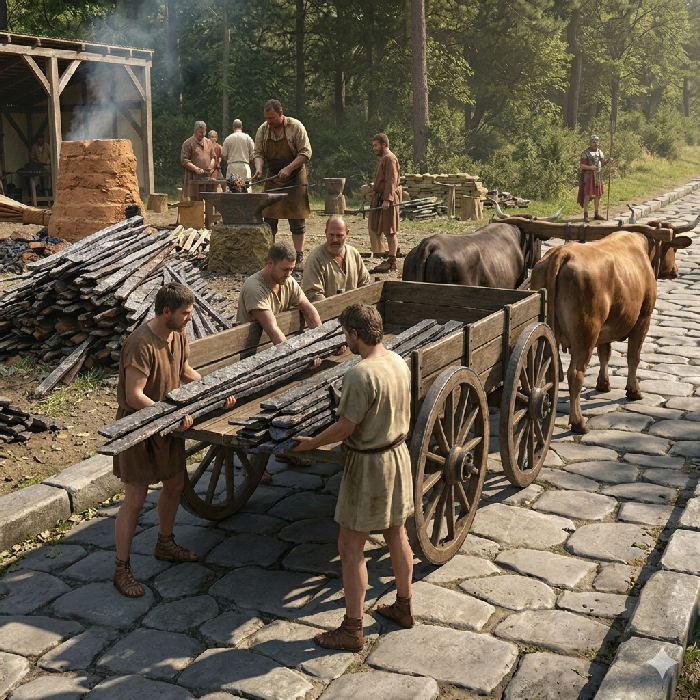 This image captures the moment refined Roman iron leaves the production site and enters the imperial supply chain, as workers load finished bars onto a heavy transport cart.
The Loading Process
Three labourers in the foreground are carefully transferring iron bars into the bed of a wooden wagon, handling only one or two at a time. This reflects the physical reality of wrought iron — a single large skelp could weigh anywhere between 5kg and 10kg, making larger loads awkward and dangerous to carry. The bars themselves are long, dark, and slightly tapered, and are being stacked neatly to prevent them from shifting during the journey.
The Cart and Oxen
The wagon is a sturdy, two-axle timber cart hitched to a pair of yoked oxen. Oxen were the Roman world's preferred beast of burden for heavy haulage — slower than horses, but far more powerful and reliable when it came to moving dense loads such as iron, stone, or grain across long distances.
The Road and Its Infrastructure
The cart sits on a Roman road, built from tightly fitted, irregular paving stones laid with a slight central camber so that rainwater drains away into stone-lined gutters running along each side. It is exactly the kind of infrastructure that made moving heavy goods across Britain practical at scale.
In the area we have the modern Sheep Street Land that goes from Bardown to Burgham on the Limden, its saxon name can derive from Sceap(sheep) or Scip(ship) so Ship Street would make more sense in this context.
Military Presence
In the background, a Roman soldier stands watch — likely a legionary or a member of the Classis Britannica, the fleet that oversaw many of the Wealden ironworking sites. His presence is a reminder that iron was not simply a commercial commodity; it was a strategic resource, state-controlled and closely guarded.
|
| |
|---|
The River Wharf: Iron Meets the Water Highway ▲ |
|---|
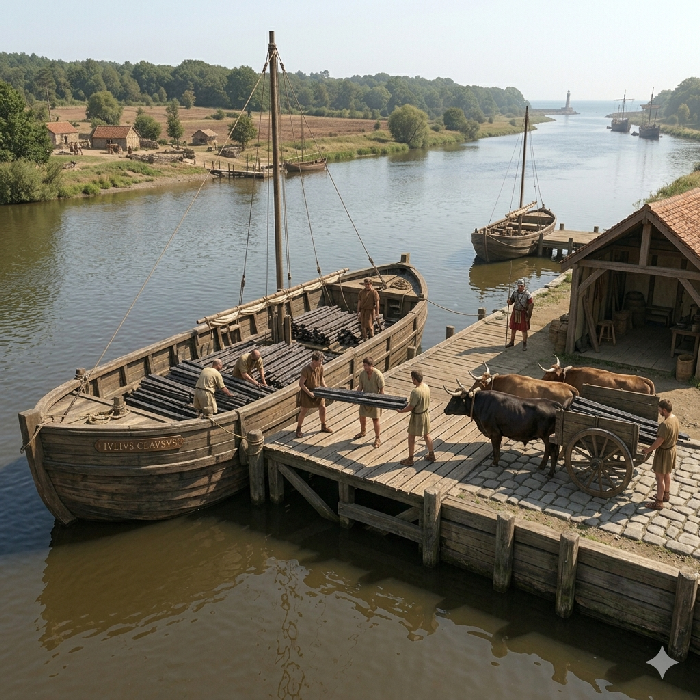 This image marks the final inland stage of the Roman iron trade, where land transport gives way to the river network. The scene is a busy riverside wharf, alive with the work of moving iron from cart to barge.
The Transshipment Process
The ox-drawn cart has arrived at a timber-reinforced stone quay, and labourers are lifting the heavy iron skelps from its bed one or two at a time. Alongside the jetty sits a large, flat-bottomed river barge — built in the tradition of vessels like the Blackfriars ship — designed with a shallow draft to navigate the winding, silt-heavy waterways of the Weald, such as the River Rother or the Medway. Inside the hull, workers are stacking the bars low and centered. This is not mere tidiness; iron is so dense that even a modest pile represents enormous weight, and poor distribution could easily destabilise or swamp a shallow-draughted boat.
The Infrastructure
The quay itself is a substantial piece of engineering — heavy timber pilings driven into the riverbank, topped with a paved surface capable of bearing the weight of laden carts and oxen. A small warehouse stands to one side, used for weighing cargo or storing supplies such as charcoal. Beyond the wharf, the river stretches toward the coast, where the masts of larger deep-water merchant vessels — corbita — are visible at anchor near the river mouth, alongside what appears to be a Roman lighthouse or signalling tower marking the transition to open water.
Supervision and State Control
A Roman official or soldier oversees proceedings from the quay — likely a representative of the Classis Britannica, the imperial fleet that administered much of the Wealden iron industry. The navy's involvement was no coincidence: iron was indispensable for shipbuilding and military hardware, making it too important to leave to private enterprise alone.
|
| |
|---|
The Harbour Crane: Iron Meets the Open Sea ▲ |
|---|
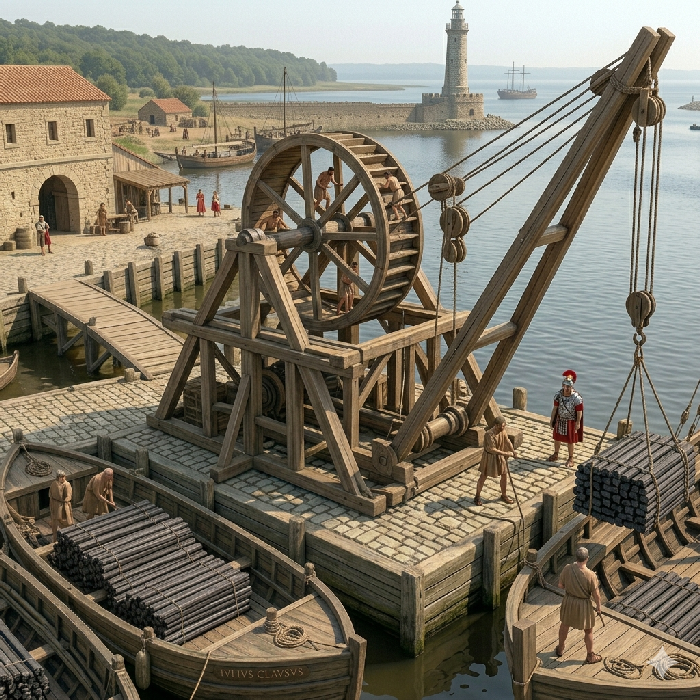 This image focuses on the final transshipment stage of the Roman iron supply chain, and the sophisticated mechanical engineering that made it possible.
The Treadwheel Crane
The centrepiece of the scene is a Roman treadwheel crane, scaled to a size appropriate for harbour work. Two labourers walk inside a large wooden wheel, their weight turning the central axle and generating the torque needed to lift heavy loads. Above, a timber A-frame supports a projecting jib fitted with a block and tackle system — a pulley arrangement that multiplied the workers' effort enough to hoist dense, high-value cargo. Suspended from it is a large bundled consignment of iron skelps, bound together with thick rope. Grouping the bars this way allowed the Romans to move hundreds of kilograms in a single lift, far faster than manual handling could ever manage.
River Barge to Sea Ship
In the foreground, a flat-bottomed river barge sits low in the water under the weight of its cargo. The crane is mid-transfer, swinging a bundle of iron from the barge across to a larger sea-going merchant vessel — a corbita — moored alongside. The contrast between the two craft is clear: the barge is open and shallow-draughted, built for inland waterways, while the corbita has high, solid sides and a deep hull designed to handle the choppier conditions of the Channel or the North Sea.
The Port and Its People
The crane stands on a heavy stone-paved pier reinforced with timber pilings, its surface strewn with ropes and stone mooring posts. A centurion or naval officer watches over the operation — a visible reminder that this is a state-run enterprise, with the cargo most likely bound for a military shipyard or a major construction project in Gaul or further afield. In the far background, a stone lighthouse stands at the harbour mouth, marking the boundary between the sheltered estuary and the open sea beyond.
|
| |
|---|
Beauport Park: A Roman Ironworking Complex ▲ |
|---|
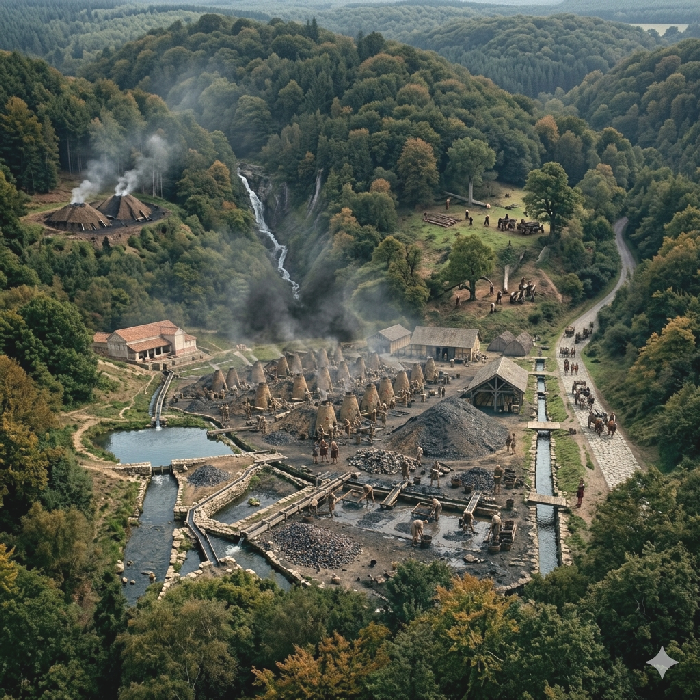 This image offers a broader view of a Roman ironworking site, loosely based on the remarkable remains at Beauport Park in East Sussex — one of the largest known iron production sites in Roman Britain, and notable for the discovery of a substantial bathhouse associated with its workforce.
The scene encompasses the full sweep of the operation: stands of timber being felled in the surrounding woodland of Silva Anderida, the great forest that blanketed much of the Weald during the Roman period; charcoal-burning mounds processing the felled wood into fuel; a row of active bloomery furnaces at the heart of the site; a growing slag heap — the accumulated waste of countless smeltings — building up nearby; and a road busy with ox-drawn carts carrying materials in and iron out.
The bathhouse, visible within the complex, is a reminder that this was not a temporary or makeshift operation. A permanent bathhouse indicates a sizeable, organised workforce living and working on site — the kind of industrial establishment that required Roman administrative oversight and, most likely, military involvement through the Classis Britannica.
|
| |
|---|
The Bathhouse at Beauport Park ▲ |
|---|
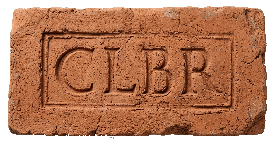
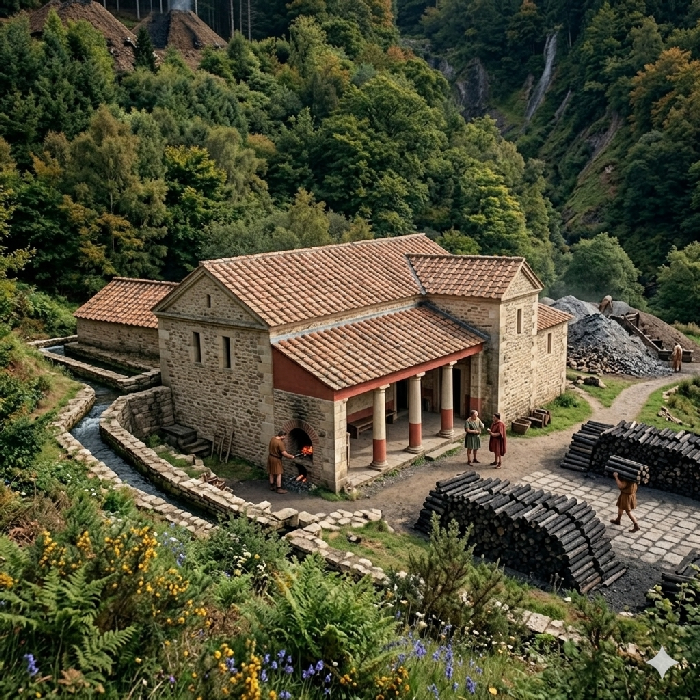 This image depicts the Roman bathhouse discovered at Beauport Park in East Sussex — one of the more unexpected findings at what was primarily an industrial ironworking complex. The bathhouse would have served the officers and men of the Classis Britannica (CLBR), the imperial fleet that administered and oversaw much of the Wealden iron industry.
Its presence is a striking reminder that even in a remote, working landscape deep in the forest of Silva Anderida, Roman standards of organised communal life were maintained. For the sailors and officials stationed at Beauport Park, the bathhouse was not a luxury — it was a routine part of daily life, as standard to a Roman military establishment as the furnaces and slag heaps that surrounded it.
The bathhouse at Beauport Park followed the classic Roman sequence of rooms, running from cold to hot in a single left to right progression. At the far left was the frigidarium, a cold room containing an unheated plunge pool where bathers would begin or end their visit, closing the pores and, Romans believed, invigorating both body and mind. Moving right came the tepidarium, a warm pool room heated by a furnace feeding in from the side of the building — a design that provided steady, gentle heat without the fierce blast of a direct end furnace, keeping the temperature pleasantly warm rather than intensely hot. Next was the caldarium, the main hot room, heated by a second furnace feeding in from the end wall and benefiting from residual warmth from both directions. Finally, at the far right and directly over the hottest part of the end furnace, sat the laconicum — a very hot, dry room similar to a modern sauna, where the intense heat would draw out the last of the day's grime and fatigue.
The use of two separate furnaces — one at the side for the tepidarium and one at the end for the caldarium and laconicum — gave the bathhouse a sophisticated level of temperature control that a single furnace could never have achieved. It meant each room could be maintained at its correct temperature independently, and the whole sequence from cold to intensely hot could be experienced as a smooth and deliberate progression. This is not the layout of a basic field installation — it speaks to a well-funded, permanently established site where the comfort and welfare of its personnel was taken seriously.
|
| |
|---|
The Hidden Danger: Lead in Roman Life ▲ |
|---|
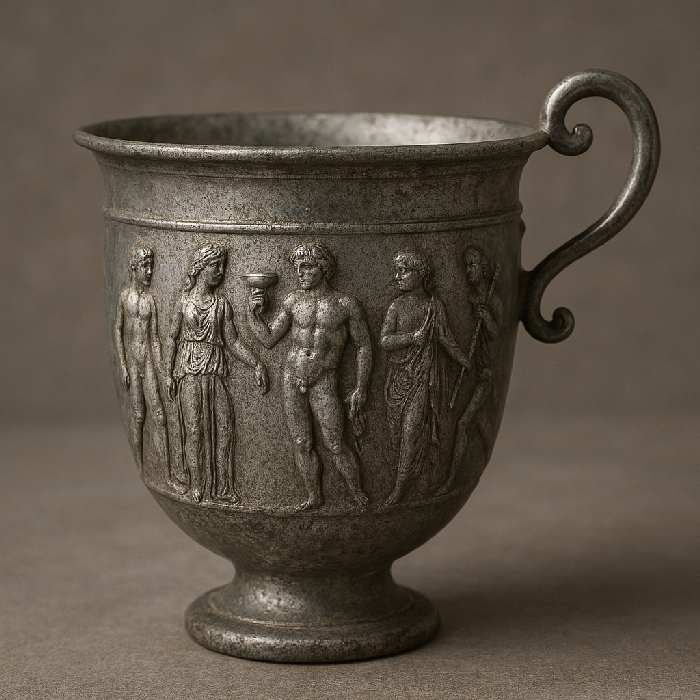 The Romans were masterful engineers, but one material they relied on almost universally would, entirely unknown to them, exact a serious toll on their health. Lead was woven into the fabric of Roman daily life to a degree that is difficult to overstate — and nowhere more so than in two of its most routine pleasures: bathing and drinking wine.
Lead in the Bathhouse
The floors and baths of a Roman bathhouse were constructed with considerable ingenuity. Brick or stone pillars supported a thick layer of terracotta tiles, roughly an inch and a half deep, which formed the base of the bathing areas. Over these tiles lay a lining of lead sheet, which provided a waterproof seal and contained the water in the baths themselves. The lead was positioned well above the furnace below — protected from direct heat by the tile layer, which prevented it from melting — but it was in constant contact with the warm water that bathers soaked in. Over time, that water became quietly infused with dissolved lead, and every visit to the baths meant absorbing a small but meaningful dose through the skin.
Lead in Wine
The bathhouse was far from the only source of exposure. Wine was central to Roman social and military life, and the Romans had discovered that boiling grape must in lead-lined vessels produced lead acetate — a sweet-tasting compound that could improve the flavour of sour or inferior wine. Pewter cups, themselves containing lead, were the standard vessel from which this wine was then drunk. The result was that a Roman raising a cup of wine was, quite unknowingly, consuming a measurable dose of lead with every sip.
The Consequences
For those most heavily exposed — the wealthy, the military, and the administratively powerful, who bathed regularly and drank wine daily — the cumulative intake of lead could be remarkably high. Chronic lead poisoning produces a distinctive and devastating range of symptoms: irritability, memory loss, cognitive decline, and eventually severe mental instability. Some historians have argued that these effects may help explain the increasingly erratic behaviour of certain Roman emperors. Nero, whose conduct grew progressively more violent and irrational, is among those sometimes cited as a possible victim of long-term lead toxicity — though whether individual cases can be attributed to it with certainty remains a matter of debate.
What is beyond doubt is that lead was silently present at the heart of Roman life, in the water they bathed in and the cups they drank from, and that its effects — though entirely invisible to those suffering them — would have shaped both individual lives and, perhaps, the course of history itself.
The Irony
It is worth noting that the bathhouses the Romans built in the name of hygiene and good health — genuinely advanced for their time — may actually have contributed to reducing life expectancy through lead exposure, even as they helped prevent other diseases. Roman public health was, in that sense, a double-edged sword.
Why is the modern symbol for Lead - Pb?
The chemical symbol for lead — Pb — has nothing to do with its English name, and everything to do with the Romans. It derives from the Latin word plumbum, the Roman term for lead, which reflected just how central the metal was to Roman life and engineering. The Romans used lead so extensively in their water pipes and plumbing systems that the very word for the craft of working with pipes — plumbing — comes directly from plumbum.
When the modern periodic table was developed and chemical symbols were assigned, lead retained its Latin identity as Pb, a small but enduring reminder that it was the Romans who, more than any other civilisation, made lead a defining material of the built world. The irony is that the metal which gave us the word for clean water infrastructure was itself quietly poisoning the people who depended on it most.
|
|
;)
)
)
)
)
)
)
)
)
)
)
)